Your website is at the heart of helping or hurting your business. There’s no compromise in 2026.
The internet is full. Page speed benchmarks are more challenging Google’s ranking signals are more sophisticated Users abandon slow or clunky sites in three seconds Yet thousands of businesses still run on off-the-shelf themes bloated with code they’ll never use, plugins that conflict with each other, and design frameworks built to serve everyone—which ultimately means they serve no one particularly well.
If your site looks like a template, it will act like one, too.
Agencies and growth businesses have made the switch quietly. They stopped gluing page builders together and started investing in architecture. That difference appears in Core Web Vitals scores, in conversion rates, in how search engines crawl and index their content – and ultimately, in revenue.
Custom WordPress development is not something that only enterprise brands can afford. It’s the least you can do for a serious online presence in 2026.
Bespoke Custom WordPress Development
Stop limiting your business with restrictive pre-made templates. We engineer hand-crafted, high-performance custom WordPress themes and robust functionalities tailored strictly to your exact vision.
Table of Contents
What Is Custom WordPress Development?
Custom WordPress development means building a WordPress-powered website from scratch – with your business needs in mind, instead of trying to fit your requirements into a pre-built theme or template.
This is a more important distinction than most people realize.
When you install a theme like Divi, Astra or any of the thousands of themes on Themeforest, you’re inheriting someone else’s assumptions. Their markup. Their CSS load. Their JavaScript dependencies. Their page builder logic. You get speed restrictions baked in before you have typed a single word of content.
Whereas a custom WordPress site is developed with purpose:
- A custom theme built for your specific design system – no unused CSS, no redundant scripts
- Custom post types + taxonomies that mirror how your business actually organizes information
- Purpose-built plugins or functionality built specifically for your workflows, not re-purposed from some generic solution
- A database schema and query structure optimised for your content model
- Bespoke REST API endpoints or headless integrations where your architecture demands them
Think of a pre-built theme as an apartment that’s already furnished – convenient, but you’re living in someone else’s taste. A custom WordPress build is a commissioned build, with every decision made for you, your users and your performance targets.
The desire for that level of technical rigor has led to startups like Codeable, which matches companies with vetted developers who only work on custom solutions. The standard they stand for — clean code, documented architecture, security-first development — is what sets professional WordPress engineering apart from DIY site building.
Custom development also means ownership. You won’t be held hostage by a page builder’s proprietary shortcodes or stuck in a theme developer’s update cycle. Your code base is your own. Your IP is your IP.
Replicate or Code Any Design Into WordPress
Have a beautiful layout or a competitor site design in mind? We provide advanced custom cloning and pixel-perfect transformations using clean code logic—giving you total control over every section.
Start Custom Project Order Securely via Fiverr MarketplaceIt's also worth clarifying what custom WordPress development is not:
- It is not changing colours and fonts in the WordPress Customiser
- It is not installing a premium theme and swapping out images
- It is not stacking plugins until the site does what you need
These approaches have a place for small projects with low requirements. But for most businesses in 2026, where performance, security and scalability are non-negotiable, they are a ceiling, not a foundation.
Why Custom Development Beats Off-the-Shelf Themes in 2026
The argument against pre-built themes isn’t philosophical. Quantifiable.
Core Web Vitals & Performance
Google’s Core Web Vitals are now official ranking factors, and they punish bloat with a vengeance. Most commercial themes come with hundreds of kilobytes (sometimes megabytes) of unused CSS and JavaScript loaded on every single page, whether the page needs it or not.
Most Divi or Avada installs, straight out of the box, will often fail the Largest Contentful Paint (LCP) and Total Blocking Time (TBT) benchmarks. Then you spend weeks installing optimization plugins to compensate for the inefficiencies of the theme itself: it is a debt cycle of architecture that has no clean way out.
A custom WordPress site fixes this at the source:
- Only the CSS your design actually uses gets compiled and served
- JavaScript is loaded conditionally, scoped to the components that need it
- HTML output is lightweight, semantic, and crawler-friendly.
- Server response times decrease, as there is no framework overhead to process.
It's not fringe. Businesses moving from bloated theme stacks to custom-coded WordPress builds consistently see 40 – 70% gains in PageSpeed Insights scores. That's not a plugin hack; that's architecture. ## Security and Vulnerability
Security & Vulnerability
Prebuilt themes are high-value targets. They are installed on millions of sites, so a single vulnerability found translates to a huge attack surface right away. Theme devs patch when they can; bad guys move faster.
The danger is made worse by plug-ins. A typical WordPress site that uses a commercial theme stack has 20 to 30 active plugins. They are each a new door. They have their own update cadence, security history, and potential for conflict.
Custom development changes this fundamentally:
- Minimal plugin footprint — core functionality is built into the codebase; it is not added on
- No publicly known attack vectors — custom code isn't indexed in vulnerability databases
- Hardened architecture — user roles, database queries, and file permissions designed with security as a first principle, not an afterthought.
- Controlled dependencies — every third-party library is vetted, version-locked, and deliberately included
For companies that manage customer data, e-commerce transactions, or sensitive content, this is not optional hardening. That’s due diligence.
Scalability
A website on a generic theme doesn’t age well. Traffic increases, product lines multiply, integrations multiply — and suddenly the limits of the theme become the limits of the business. You’re either restricted by what the page builder supports or you’re paying a developer to fight the theme’s own architecture.
Custom WordPress architecture is built to grow. Custom post types and taxonomies scale with your content model. API integrations are built cleanly, not crammed through plugin middleware. The codebase was never carrying dead weight, so it continues to perform under load.
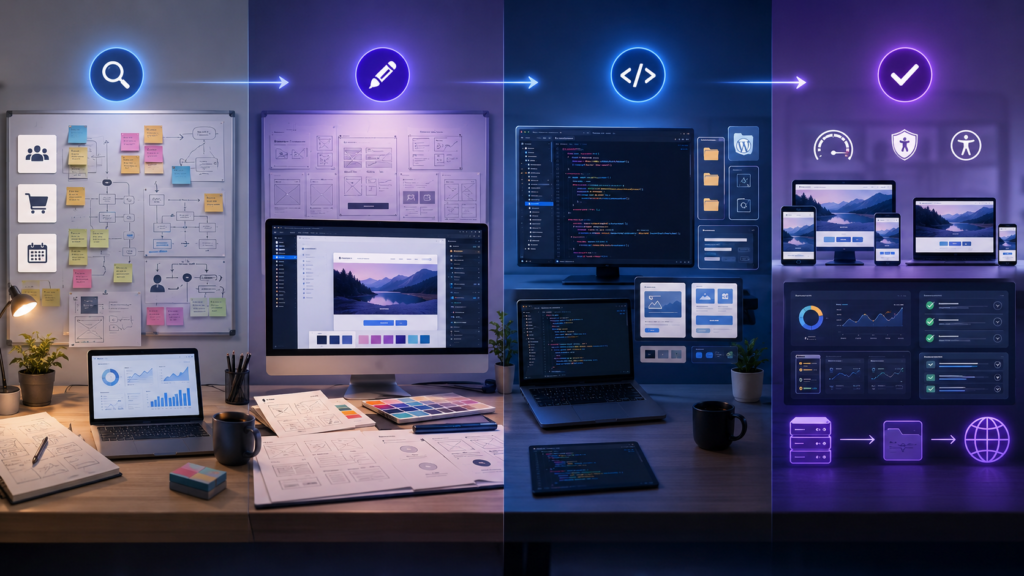
The Custom WordPress Development Process: From Discovery to Deployment
WordPress web design and development is a painstaking process. Even custom sites that are underperforming are usually the result of skipped steps. Here's how rigors custom builds are structured.
1. Discovery & Planning The scope has to be defined precisely before writing a line of code. This includes evaluating the performance and shortcomings of your current website, creating user journey maps, defining integrations (CRM, e-commerce, and booking systems), and establishing technical requirements. A good discovery phase stops costly scope changes during the build.
2. Wireframing & Design Wireframes define content hierarchy and UX logic before visual design. We then create high-fidelity mockups aligned to your brand system using tools such as Figma once approved. This is where affordable WordPress website design decisions are made — solving layout and interaction at the design level is dramatically cheaper than rebuilding after development.
3. Custom Theme Coding This is the heart of the build. Custom theme built off approved designs: Clean PHP templates and well-structured functions. PHP, properly enqueued assets, modular component architecture. In cases where Elementor Pro is employed for layout flexibility, it is used with discipline: custom widget registration, stripped-back global styles, and no reliance on Elementor's default bloated CSS. The builder is in service of the design system, not vice versa.
4. QA & Testing Cross-browser testing, mobile responsiveness, accessibility audits (WCAG 2.1 compliant), performance benchmarking, and security scanning before any deployment. Staging environments are the same as production. Nothing ships unless it is end-to-end validated.
WordPress Website Development Company vs. Freelance Experts
The right answer depends on what you’re actually building.
A WordPress website development company provides process, accountability, and multidisciplinary capacity—project managers, designers, developers, and QAs working in coordination. That structure is extremely useful for complex builds with hard deadlines.
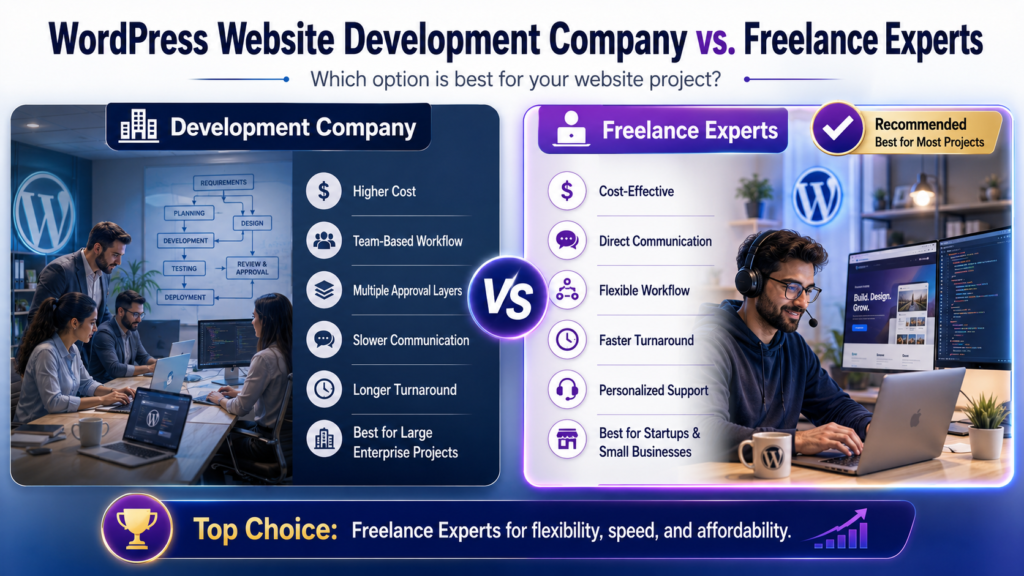
But freelance specialists provide something agencies often can't—complete focus. Fiverr has a pool of rigorously vetted WordPress pros who only do custom development—no account managers, no handoffs, and direct access to the person writing your code. If your business wants technical depth with real one-to-one attention, that relationship often delivers better results than an agency workflow where your project competes for senior developer time.
The best way? Match the engagement model to the size of the project. Whatever the case, specialization is non-negotiable; generalists don’t build performant custom WordPress.
The Modern Tech Stack for High-Performance WordPress Sites
Tools don't make a developer. But the right tools, used with discipline, make a custom WordPress site significantly easier to maintain, scale, and hand off. In 2026, the professional stack has consolidated around a core set of technologies that balance flexibility with performance.
Elementor Pro — Misunderstood, Not Obsolete
Elementor has a reputation problem in developer circles. That reputation is earned — when used carelessly, it produces some of the most bloated front-end output in the WordPress ecosystem. But dismissing it entirely misses the point.
When implemented correctly within a custom build, Elementor Pro remains one of the most capable layout engines available:
- Custom widget development lets you register your own Elementor widgets backed by clean, template-driven PHP—output stays semantic and minimal.
- Global design system controls enforce typography and color consistency without inline style soup.
- Theme Builder handles dynamic template areas (headers, footers, archive pages, and single post templates) with a visual interface that non-developers can update without touching code.
- Loop Builder enables complex dynamic content layouts driven by custom queries—no shortcode hacks required
The key principle: Elementor is a layout interface, not an architecture. The architecture still lives in your custom theme, your functions. php, your template hierarchy. When that foundation is solid, Elementor adds genuine capability without compromising performance.
Advanced Custom Fields (ACF) — Structured Data Done Right
ACF is the standard for a reason. For any custom WordPress site handling complex content—service pages, team directories, testimonials, pricing tables, and property listings—ACF provides the structured data layer that WordPress's native editor simply wasn't designed for.
Rather than forcing editors to construct content from Gutenberg blocks, ACF gives you the following:
- Field groups mapped to specific post types, page templates, or user roles
- Repeater and flexible content fields for dynamic, editable layouts without developer involvement post-launch
- ACF Blocks for custom Gutenberg block registration using familiar PHP templates
- Clean database storage that makes content portable, queryable, and API-accessible
For developers offering custom WordPress development services, ACF is typically a non-negotiable inclusion. It's the difference between a site the client can actually manage and one that requires a developer for every content update.
Essential Plugins & Integrations for Custom Builds
The plugin philosophy for custom builds is selective by design: every addition must earn its place. Here are the categories that consistently justify inclusion.
Technical SEO—SureRank and Beyond SureRank have emerged as strong contenders for projects where clean, lightweight SEO tooling is a priority—no feature bloat, focused on the on-page and technical signals that move rankings. For larger builds with more complex SEO requirements, combining a lean SEO plugin with dedicated schema markup, XML sitemap control, and crawl monitoring via Google Search Console covers the full technical stack without redundancy.
Lead Generation — WPForms Lite WPForms Lite handles standard lead capture cleanly and without the performance overhead of heavier form builders. For custom builds, the focus is on conditional logic, confirmation routing, and direct CRM integration — not decorative form styling. Forms should convert, not impress.
Live Chat & CRM Integrations For service businesses and agencies, live chat isn't optional — it's a conversion layer. Integrations with tools like HubSpot, Intercom, or Crisp connect visitor behavior directly to your sales pipeline. The implementation detail that matters: load chat widgets asynchronously and defer non-critical scripts so they don't affect Core Web Vitals. A chat tool that tanks your LCP score is net negative, regardless of how many leads it captures.
The Business ROI of a Custom WordPress Site
Here's the conversation that separates strategic WordPress website developers from those who simply build pages: return on investment.
A custom build costs more upfront. That's a fact. But framing it as an expense misunderstands what it actually is—a performance asset with measurable returns.
Conversion Rate Optimization (CRO) A site built around your specific user journeys — with purposeful content hierarchy, fast load times, and friction-free pathways to conversion — consistently outperforms template-based alternatives. A 1–2% improvement in conversion rate on a site generating £500,000 in annual revenue isn't a minor gain. It's material. Custom architecture is what makes that kind of targeted optimization possible.
Lower Long-Term Maintenance Costs Bloated theme stacks break. Plugins conflict. Page builders release updates that alter your layouts. The ongoing cost of maintaining a poorly architected site—in developer hours, downtime, and emergency fixes—routinely exceeds the initial saving from choosing a cheaper build.
Custom code is stable because it's purposeful. There's nothing unnecessary to break.
Scalability Without Rebuilding A business that outgrows its website loses momentum at exactly the wrong moment. Custom WordPress development services are designed to anticipate growth — the architecture accommodates new functionality, higher traffic, and additional integrations without requiring a full rebuild every 18 months.
The developers worth hiring aren't the ones who ask, “What pages do you need?” They're the ones who ask, “What does this site need to do for your business in three years?” That distinction — between builders and strategic partners — is ultimately what justifies the investment in custom WordPress development.
Future-Proofing Your Investment: Maintenance and Security
A custom WordPress site is a precision tool. As with any high-performance system, it requires professional maintenance.
Core WordPress, theme files, and any integrated plugins need regular, tested updates in a staging environment before touching production. Security scans, uptime monitoring, database optimization, and performance audits are not “add-ons.” They are the constant cost of keeping a business-critical asset running at the level it was built for.
A professional maintenance plan is not an upsell. It’s the difference between a site that adds value over time and a site that slowly degrades until something breaks at the worst possible time.
Custom WordPress Development Cost Table
| Item | Basic Website | Business Website | Advanced / Custom Website |
|---|---|---|---|
| Domain Name | $10 – $25 / year | $10 – $25 / year | $10 – $50+ / year |
| Web Hosting | $3 – $15 / month | $15 – $40 / month | $40 – $150+ / month |
| SSL Certificate | Free – $100 / year | Free – $100 / year | Free – $300+ / year |
| Premium Theme | Free – $80 / year | $50 – $150 / year | Custom theme: $500 – $5,000+ |
| Page Builder | Free – $60 / year | $60 – $200 / year | $200 – $400+ / year |
| Essential Plugins | Free – $150 / year | $150 – $500 / year | $500 – $2,000+ / year |
| Custom Design | $100 – $500 | $500 – $2,000 | $2,000 – $10,000+ |
| Custom Development | $300 – $1,500 | $1,500 – $5,000 | $5,000 – $25,000+ |
| WooCommerce Setup | Optional: $300 – $1,000 | $1,000 – $5,000 | $5,000 – $20,000+ |
| SEO Setup | $100 – $500 | $500 – $2,000 | $2,000 – $8,000+ |
| Speed Optimization | $100 – $500 | $500 – $1,500 | $1,500 – $5,000+ |
| Security Setup | $50 – $300 | $300 – $1,000 | $1,000 – $5,000+ |
| Maintenance | $30 – $100 / month | $100 – $500 / month | $500 – $2,000+ / month |
| Content Writing | $50 – $300 | $300 – $1,500 | $1,500 – $10,000+ |
Conclusion:
The businesses winning online in 2026 are not winning because they found a better template. They are winning because they made a deliberate decision to build something that actually works — architecturally sound, performance-optimised, secure by design, and built around real user journeys and real business objectives.
A custom WordPress site isn’t a luxury for brands with deep pockets. This is what makes sense in a digital environment where technical standards are higher, competition is tougher, and the difference between a well-built site and a mediocre one is measured directly in revenue.”
Templates had a purpose. That purpose is achieved.
Ready to stop settling?
If there’s one thing this guide has made clear, it’s that the quality of your website is a direct reflection of how serious you are about your business. Visitors read it at once. Search engines are constantly measuring this.
The next step is simple. Go to Fiverr and find an experienced professional in custom WordPress development services – a developer who builds with intention, communicates effectively, and understands that what they’re building isn’t just a website. This is your business’s single most valuable digital asset.
Stop fixing templates. No more compromises in performance. Stop giving your brand to a framework that was never designed for your goals.
Get the custom WordPress site your business deserves and build something that lasts.
Premium Custom WordPress Development Company
Custom Plugin Configurations • Scalable API Integrations • Specialized Layouts
FAQ:
What exactly is custom WordPress development in 2026?
In 2026, custom WordPress development is about designing a website where all of the layers—the theme architecture, the database structure, the functionality, and the performance optimization—are crafted for your business. It is not a theme customization. It’s not a page builder logo switch. It’s purpose-built from the ground up, with a codebase that reflects your requirements, not what the template developer thought they were.
The 2026 standard is even more ambitious: custom builds are now expected to ship with Core Web Vitals baked in from day one, accessibility standards met without retrofitting, and headless or hybrid architecture considered where performance demands it. In 2026, custom WordPress sites are a software product as much as a website.
Can a professional developer be replaced by AI builders like ZipWP?
Maybe. For basic brochure sites with few functional requirements. For anything that has any real business logic, the answer is certainly no.
AI-generated code is also notoriously opaque — hard to audit, hard to extend, hard to hand off to another developer when something breaks. Custom WordPress Development Services Professional WordPress development services build custom, documented, maintainable codebases that are owned and controlled by your business. AI tools are optimized for speed of generation, not longevity of operation.
Prototype ideas with AI builders. Not to run a business on.
How to select the right WordPress website developers?
In fact, this is the best place to start. You can find talented freelancers on platforms like Fiverr or the official WordPress Job Board. The issue is that some of the best WordPress developers aren’t advertising their services on job boards.
Is WordPress Still the Best CMS for Business in 2027?
The market has voted, repeatedly and overwhelmingly. WordPress still powers over 43% of the web globally, and that number has continued to grow year on year despite the rise of Webflow, Framer, Squarespace, and a host of headless CMS alternatives.
So, by 2026, it’s not a question of whether WordPress is a viable CMS choice. It’s whether the way you implement it lives up to the platform