
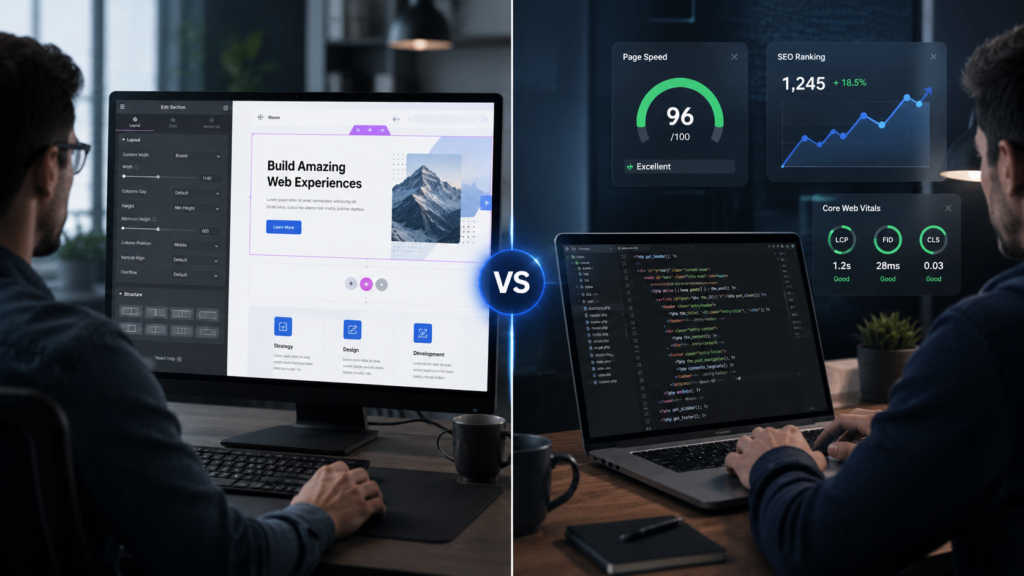
I still remember the first time I had to choose between Elementor and a custom WordPress theme. I was helping a small business owner. He wanted a beautiful website, fast loading, and better Google rankings.
At first, Elementor felt perfect. I could drag a section, add a button, change colors, and show the design fast. The client was happy because he could see the website growing live.
But later, some pages became heavy. A few widgets were not needed. Extra scripts were loading. That was when I started taking elementor vs. WordPress theme comparison, performance, and SEO seriously.
This guide is not here to attack Elementor. It is also not here to say custom WordPress is always perfect. I want to explain Elementor vs. WordPress Theme Comparison both in simple from a real, working point of view.
Table of Contents
What the Comparison Means
WordPress is the main website platform. A theme controls the design and layout. Elementor is a page builder plugin that helps you design pages with drag-and-drop tools.
So, when people search for “Elementor vs. WordPress theme comparison performance SEO,” they usually want to know this: should I build with Elementor, or should I use a clean WordPress theme, often a custom one?
Elementor is strong for visual design. It is helpful for people who do not code. Custom WordPress themes are strong for cleaner structure, speed, and long-term control when they are built well. The reference articles broadly agree that Elementor is useful for quick design and editing, while custom themes often give more control over speed, code, and growth. (Studio Ubique)
Quick Comparison Table
| Area | Elementor | Custom WordPress Theme |
|---|---|---|
| Ease of use | Very easy | Needs developer skill |
| Design speed | Fast | Slower at first |
| Performance | Good if optimized | Usually stronger |
| SEO control | Good with plugins | Deeper control |
| Editing | Visual and easy | Safer and controlled |
| Future growth | Good for simple sites | Better for complex sites |
AreaElementor Custom WordPress Theme Ease of use Very easy, needs developer skill. Design speed: Faster/slower at first performance Good if optimized Usually stronger SEO control Good with plugins Deeper control, visual, and easy Safer and controlled Future growth is good for simple sites. Better for complex sites
Elementor vs. WordPress theme comparison: performance and SEO: Performance and Speed
Speed is one of the biggest parts of the Elementor vs. WordPress theme comparison: performance and SEO. A website should open fast, especially on mobile. People leave when a page takes too long.
Elementor has many design tools. But these tools can add extra CSS, JavaScript, and HTML. If you use too many sections, sliders, popups, animations, and add-ons, the page can become slow. Appeal Digital explains that page builders may include unused features and extra code, while a well-written custom theme can stay more streamlined. (Appeal Digital)
A custom WordPress theme can be lighter. A developer can load only what each page needs. This can help page size, Core Web Vitals, and user experience.
Still, Elementor is not automatically slow. A careful Elementor build can perform well with good hosting, compressed images, caching, fewer plugins, and clean sections. Studio Ubique also says a well-built Elementor site can beat a badly built custom theme. (Studio Ubique)
My simple view is this: for best raw speed, a clean custom theme usually wins. For a quick launch with good speed, Elementor can still work. This is why I treat the Elementor vs. WordPress theme comparison, performance, and SEO as a planning question, not only a design question.

Elementor vs. WordPress Theme Comparison: Performance and SEO: SEO and Clean Structure
SEO is not only about keywords. It is about fast loading, clear headings, mobile design, internal links, schema, clean HTML, and useful content.
This is why Elementor vs. WordPress theme comparison, performance, and SEO matter for business owners. If your market is competitive, small technical wins can help.
Elementor can work with SEO plugins. You can write meta titles, meta descriptions, headings, image alt text, and content blocks. For many small websites, this is enough.
A custom WordPress theme gives deeper control. Developers can create clean templates for service pages, products, blogs, FAQs, and landing pages. They can also build better schema areas and cleaner HTML. Back9 Digital notes that Elementor can support SEO, but custom WordPress often gives cleaner code, faster loading, and more flexibility for technical SEO. (Back9 Digital)
My opinion is clear. Elementor is good for SEO when built properly. A custom theme is better when SEO is a serious long-term business channel.
SEO and Performance Checklist
| Task | Elementor Site | Custom Theme Site |
|---|---|---|
| Compress images | Must do | Must do |
| Use fast hosting | Must do | Must do |
| Limit plugins | Very important | Important |
| Keep headings clean | Must check often | Easier to control |
| Add schema | Usually plugin-based | Can be custom-coded |
| Test mobile speed | Must test every page | Can be planned in templates |
Task: Elementor Site, Custom Theme Site, Compress Images Must do. Must do. Use fast hosting. Must do, must do, limit plugins. Very important. Keep headings clean. Must check often Easier to control Add schema, usually plugin-based. Can be custom-coded to test mobile speed. Must test every page Can be planned in templates
Editing and Design Control
One big reason people love Elementor is freedom. You can open a page and change the design visually. You can test a new hero section, button, form, or landing page without waiting for a developer.
In the Elementor vs. WordPress theme comparison, performance and SEO are where Elementor gets strong points. It is useful for small teams, freelancers, local businesses, and landing pages.
But too much freedom can create a mess. I have seen websites where one person changed the font size, another changed spacing, and another added new widgets. After some time, the brand looked weak.
A custom WordPress theme can give safer editing. The developer can create fixed blocks. The team can change text and images, but they cannot break the full design. This is better for serious brands that want a clean look on every page.
Good planning makes the Elementor vs. WordPress theme comparison performance and SEO easier for any business owner.
Personal Experience From My Life
From my own work, I learned this: most clients ask for beauty first, then speed later.
I once helped with a service website where the first goal was a premium look. Elementor helped us build the first version quickly. The client could give feedback fast. It saved time.
But after adding more pages, forms, tracking scripts, and design blocks, the site needed cleaning. We removed unused widgets, compressed images, reduced plugins, and tested mobile speed. That project taught me that Elementor needs discipline.
In another project, the client wanted long-term SEO growth. The site needed many service pages and blog templates. A custom WordPress theme made more sense. It took longer in the beginning, but it gave cleaner structure and easier growth.
That is why I never choose tools by emotion. I choose by goal. For a simple brochure website, Elementor can be enough. For a large SEO website, custom WordPress usually gives more power. This is the real heart of the Elementor vs. WordPress theme comparison: performance and SEO.
Cost and Future Growth
Cost is not only the first payment. It also includes updates, plugin renewals, speed fixes, security care, and future changes.
Elementor can cost less at the start. It is also faster to build. This is good for startups, personal brands, and small businesses. But if the site grows, you may need more plugins, better optimization, and expert support.
A custom WordPress theme can cost more at first. But it can save time later when you need custom templates, filters, post types, membership features, or advanced SEO structure.
WordPress itself is not outdated in 2026. The official theme directory lists over 14,000 free themes, and the WordPress plugin team reported that plugin submissions rose sharply into 2026. This shows the ecosystem is still active. (WordPress.org)
So, in the Elementor vs. WordPress theme comparison for performance SEO, think beyond today. Ask: Will this website grow? Will SEO bring leads? Will the design need strict brand control?
Best Choice Table
| Website Need | Better Choice | Reason |
|---|---|---|
| Simple business site | Elementor | Quick and easy |
| Personal portfolio | Elementor | Visual editing helps |
| Landing pages | Elementor | Fast testing |
| SEO-heavy service site | Custom theme | Cleaner structure |
| Large blog hub | Custom theme | Better templates |
| Complex directory or membership | Custom theme | Stronger logic |
Website Needs Better Choice Reason Simple business site: Elementor: quick and easy Personal portfolio Elementor visual editing helps. Landing pages, Elementor, fast testing SEO-heavy service site Custom theme cleaner structure Large blog hub Custom theme, better templates Complex directory or membership Custom theme, stronger logic
If your website is small and you want quick design control, Elementor is smart. If your website is your main SEO asset, a custom WordPress theme is usually stronger.
Our WordPress website design team can help.
I shared my thoughts as one person. But for the actual WordPress website design service, we work as a team.
Our team can build Elementor websites, custom WordPress-style websites, landing pages, business sites, and SEO-friendly layouts. We do not only focus on beauty. We also plan speed, mobile layout, page structure, user flow, and basic SEO setup.
Need expert help with Elementor vs. WordPress theme comparison, performance, and SEO before building your site?
My Professional Recommendation
Choose Elementor if you need a clean website quickly, have a smaller budget, and want easy editing.
Choose a custom WordPress theme if you care deeply about speed, long-term SEO, clean code, brand control, and future growth.
For many small businesses, a well-built Elementor site is enough. For serious SEO projects, big content sites, and competitive markets, a custom WordPress theme is usually the better choice.
This is the simple truth behind the Elementor vs. WordPress theme comparison, performance, and SEO. It is not only builder versus theme. It is short-term ease versus long-term control.
If you are not sure which option fits your business, our team can guide you and build the right website for your goal.
💡 Have Custom Web Design Requirements?
Get a personalized quote directly tailored for your business needs. Message me on Fiverr anytime!
Conclusion:
When I look at Elementor vs. WordPress theme comparison performance and SEO, I see two useful paths.
Elementor is easy, visual, and fast to launch. It is great when you want simple editing and a beautiful design without a long build process.
A custom WordPress theme is cleaner, stronger, and better for deep SEO and performance work. It is better when your website must grow for years.
The best choice is not based on trend. It is based on your goal. Build with a plan, and both can work. Build without a plan, and both can fail.
The best Elementor vs. WordPress theme comparison performance SEO answer is the one that matches your real website goal.
For a fast, clean, and SEO-ready WordPress website, our team is ready to help with elementor vs. WordPress theme comparison, performance, and SEO.
Work with @wordpress_seoxp on Fiverr
100% Secure Transaction • Unlimited Revisions • Responsive Design Specialist.
FAQs
Which WordPress theme is best for SEO?
A fast, clean, lightweight theme is best. Custom themes, GeneratePress, Astra, and Kadence are common good options.
Is WordPress outdated in 2026?
No. WordPress is still active and supported by a large theme and plugin ecosystem.
Is Elementor Pro good for SEO?
Yes. Elementor Pro can be good for SEO if the site is clean, fast, and properly optimized.
Is WordPress optimized for SEO?
WordPress is SEO-friendly, but you still need good content, fast hosting, clean design, and SEO plugins.